

Falconry
What is Falconry?
Falconry is hunting wild quarry in a natural state with trained birds of prey. It is one of the oldest forms of hunting and is practised in many countries around the world. Falconry worldwide currently involves the use of both wild birds and domestically produced birds, including captive breeding from permanently injured wild birds.
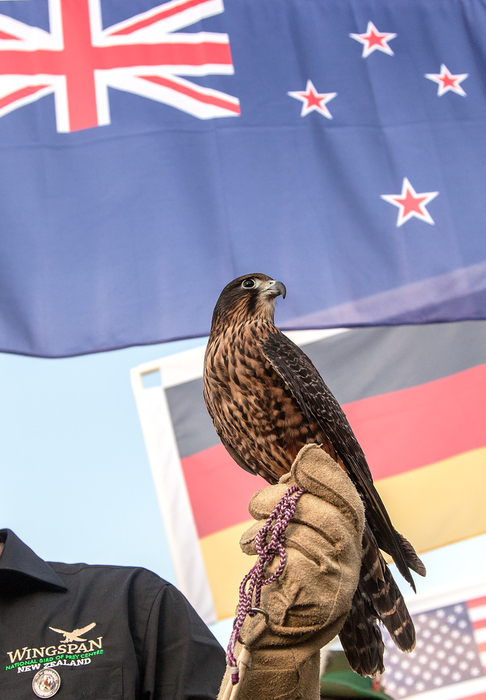
When visiting the Wingspan National Bird of Prey Centre you enter the world of falconry. In our museum you will learn about the history of this ancient practice and during our flight displays we showcase falconry techniques and demonstrate how Wingspan uses this age-old art to help the conservation of the threatened New Zealand falcon. You will see the spectacular flying skills of falcons as they stoop and chase the falconer’s lure. If you're lucky you may see a falcon chase and catch its prey!

The History of Falconry Around the World.
The practice of falconry goes back some 4000 to 6000 years BC possibly originating in East Asia on the steppes of Mongolia or in the Persian Gulf region of the Middle East where it was well established by 2000 BC.
Falconry was originally used as a means of sustenance and has been practised in many forms by many cultures around the world. From the 6th Century through the Middle Ages, falconry’s popularity surged. It was the sport of royalty for centuries with the possession of birds of prey considered a status symbol. For example, in 17th Century England falconry was governed by a strict set of customs that dictated the birds of prey allowed to be flown by people of various social ranks. For instance, only a king could fly the largest and most magnificent of falcons, the gyrfalcon, while only a prince could fly a female peregrine (known simply as ‘a falcon’ in falconry terminology); noblewomen could only fly a merlin, and knaves, servants or children could only fly a Eurasian kestrel.
By the 1800s the sport began to diminish due to the invention and increased use of firearms to obtain food. However, by the turn of the 20th century interest in falconry began to rise again. Today about 80 countries worldwide practise falconry and in 2010, in recognition of its long cultural history, falconry was inscribed as a living human heritage on the UNESCO Representative List of Intangible Cultural Heritage of Humanity.
The History of Falconry in New Zealand.
There is no known evidence of Māori using birds of prey for hunting prior to the arrival of Europeans. However, records show that falconry has been practised in New Zealand now for some 100 years. The Raptor Association of New Zealand was established in the 1970s with the aim of supporting research, rehabilitation and falconry. At that time harriers were an unprotected species and were available to falconers without the need for a permit from the then New Zealand Wildlife Service. The founding meeting of the Raptor Association was a falconry group meeting in the Waihopai Valley in Marlborough, where falconers hunted with their birds. Harriers became partially protected in 1985 and as such could not be held without a permit under the Wildlife Act (1953).
Despite permits being issued for harrier destruction, when they were perceived to be causing economic or other harm, the passion of a core group of falconers did not waiver. Then in 2010 with the rescheduling of the harrier in the Wildlife Act, the first permits for legal falconry with harriers in New Zealand were issued by the Department of Conservation.
Wingspan has and continues to work closely with DOC to make sure that suitable guidelines and policies are implemented and enforced to ensure the responsible management and welfare of all the birds used in falconry in New Zealand.
Wingspan is a member of The International Association of Falconry and has represented the falconers of New Zealand at multiple International Festivals of Falconry.
In 2011 The New Zealand Falconers Association (NZFA) was established to support and ensure the longevity and responsible practice of falconry in New Zealand. The NZFA’s inaugural meeting was held at the International Festival of Falconry in Al Ain, UAE - a fitting location if ever there was one!
The Language of Falconry
You probably don’t realise – we all talk the language of falconry! Having such a long and rich history around the world, the practice of falconry has developed an extensive vocabulary to describe it. Over time many of these words and phrases have become part of everyday life without many of us realising the original meaning behind the term.
For example:
"I’m just so fed up with all this work."
The term to be 'fed up' comes from the falconry term for when a trained hawk has eaten its fill. When a bird is 'fed up' it is unwilling to fly and hunt for the falconer. Hence today, to be 'fed up' means you are no longer interested in doing something.
"That guy is so under her thumb!"
To be under the thumb, comes from the action of a falconer holding the leash of the hawk under their thumb to maintain a tight control of the bird. Today the term under the thumb is generally used in a derogatory manner to describe a partner's overbearing control over the other partner's actions.
"Ha ha - he's been hoodwinked!"
Falconers use a leather 'hood' to cover a hawk's eyes and keep them calm. Hence the term hoodwinked came about to describe somebody being fooled or tricked into doing something.
"Noel has been working too hard - he’s looking a bit haggard!"
A haggard falcon was traditionally a bird that was caught from the wild while on migration. Typically a bird caught at this time would be thin and tired from its journey. Hence the term looking 'haggard' means that they look a bit rough around the edges, a bit worn out.
“She’s been waiting with bated breath all day”
Falcons, when they want to fly, bate from the block, meaning they try to fly but are held short of leaving the area around their perch by their leash. When doing this they can become short of breath – and hence are waiting for the falconer to come to release them from their tether with 'bated breath'. The term “at the end of my tether” similarly comes from the action of a falcon, particularly an un-trained young falcon, bating from the perch and being held up by their tether – hence they are at the end of their tether i.e. extremely frustrated.
"Ok, I will cadge a lift off Tom."
A cadge was what falconers called a portable perch. Falcons were carried to the hunting grounds on a cadge. Thus the term to 'cadge a lift' came about, meaning to get a free lift. Phrases based on the word cadge don’t end there. 'Codger' is a derivative of the word 'cadger'. Cadgers were usually old falconers (who carried the falcons on the cadge) hence today the term has come to be used to refer to an elderly person, as in the affectionate term – 'the old codger'. Interestingly, a caddy today is somebody who carries golf clubs for somebody – and normally the person carrying the clubs is considerably younger than the person playing the game!
"I’m off down the boozer."
When raptors drink, it is called bowsing. A bird that drinks heavily is called a boozer. The same term is used to describe the same tendency in humans – hence a 'boozer' is someone who drinks a lot, and the 'boozer' is where people that drink beer like to go for a drink (or two).

Falconry and Conservation
Falconers and falconry techniques have been at the forefront of raptor conservation for centuries. Indeed, most of the falconers in New Zealand today are involved in raptor conservation.
Understanding the behaviour and needs of a bird of prey is only part of being a successful falconer; awareness and knowledge of the environment we share with birds of prey is also vital. As such, falconers generally not only have a deep spiritual association with their birds but also with the natural world and many are raptor biologists or ecologists. There are many examples of falconers being at the forefront of action to save threatened species and the habitats they live in. For example, falconers have been some of the most important pioneers of captive breeding and release techniques for conservation purposes, helping save many species from the brink of extinction (e.g. peregrine falcon, Mauritius kestrel, aplomado falcon, Californian condor and the bald eagle).
The contribution by falconers to bird of prey conservation continues today with organisations like Wingspan Birds of Prey Trust, an organisation established and run largely by falconers, leading conservation action to save the threatened New Zealand falcon.
Falconer Requirements | Becoming a Falconer
Falconry requires a high commitment of time, resources and skill. The key word here is commitment. Many people like the idea of becoming a falconer; few have the time, patience, knowledge, skill, or commitment to follow through and actually become a falconer. Training a bird of prey to hunt and catch quarry requires understanding the bird, the world it lives in and how it responds behaviourally to it. Above all a falconer is responsible for the welfare of the bird that is in their care, and this is a commitment that should not be taken lightly.
Part of the joy of becoming a falconer is sharing your experiences and learning from others with the same passion. Join Wingspan. Join the NZFA. Become involved. Talk to us and help us maintain the standards necessary to ensure that everyone can enjoy this unique sport and the birds we love.
